 Blender
 Motion Builder
 3ds Max
Ardy. NVIDIA's real-time motion model.
10 generations a month on the free plan. No card. See pricing
Runs inside


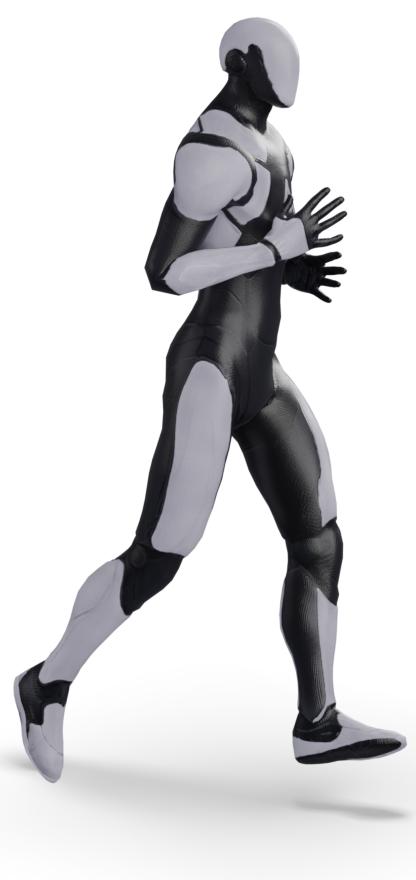
Ardy is NVIDIA's motion model for interactive character animation, published with ETH Zürich in July 2026. Describe the action, set the poses it has to hit and the path the character takes, and it generates the motion.
It was trained on a 27-joint skeleton of its own, which is almost certainly not the one your character uses. That is the part Animatica does: send the rig you have and the motion comes back on its joint names, inside the DCC where you work.
- What it is
- Autoregressive diffusion for interactive human motion. ARDY, July 2026
- Trained by
- NVIDIA, with ETH Zürich. Animatica built the workflows around it, not the model.
- Canonical rig
- ardy-core-rp, 27 joints with joint naming of its own
- Runs in
- Blender, Motion Builder and 3ds Max. The model list is read live from the server.
- Output
- Not published yet.
- Upstream
- nv-tlabs/ardy, Apache-2.0 code. The weights are NVIDIA's, under their Open Model License.
- Training data
- NVIDIA's, and outside our control. See the model index.
- Our commitments
- Cover the models we train ourselves, so they do not cover Ardy.
What Ardy does.
- 01
Keys it has to hit
Key the poses that matter and Ardy animates the frames between them.
- 02
Paths to follow
Draw a curve in the viewport and the character travels it.
- 03
Text to motion
Describe the action and Ardy animates it. You can rewrite the description while it runs, which is the thing Ardy does that Kimodo does not.
Ardy is in the model list the moment you install the plugin.
Get the pluginYou do not rebuild your rig for Ardy.
Every model publishes the skeleton it was trained on, and they do not agree. Ardy's is ardy-core-rp, 27 joints named its own way; Kimodo's is 30 joints that sit inside the 77 of the SOMA rig. NVIDIA has not released a SOMA build of Ardy, so that difference is theirs rather than ours, and neither skeleton is the one your character is built on.
You never build Ardy's skeleton yourself. Send the character you have, and the motion arrives on its own joints, ready to edit. The skeleton docs cover what to check afterwards.
Questions.
- What is Ardy?
- NVIDIA's autoregressive diffusion model for interactive human motion, published with ETH Zürich in July 2026 as ARDY. Animatica runs it alongside Kimodo, so the plugin you already have can reach it.
- Is Animatica's Ardy the same thing as NVIDIA's ARDY?
- Yes. ardy-core-rp is the skeleton NVIDIA trained ARDY on, and their published checkpoints are named for it: ARDY-Core-RP-20FPS-Horizon40 and Horizon8, plus two for the Unitree G1.
- Why does Ardy build its own skeleton?
- Because NVIDIA trained it on one. Ardy publishes a 27-joint skeleton with its own joint naming, and their SOMA build is not out yet, so the rig Kimodo uses does not fit it. Pick Ardy and Create Skeleton builds Ardy's rig instead of the built-in SOMA one.
- Can I use Ardy on a rig it was not trained on?
- Yes, and that is the normal case. Your rig's hierarchy goes with the request, the server retargets, and the motion arrives on your own joint names.
- Is Ardy open source?
- The code is Apache-2.0 at nv-tlabs/ardy. The weights are NVIDIA's, under their Open Model License.
Generate on the rig you already have.
10 generations a month on the free plan. No card. See pricing